
Every state agency leads with the same fact, because the rest only makes sense after it.
No ice is ever 100 percent safe. Ice forms unevenly, changes by the hour, and the same lake can be a foot thick in one spot and an inch thick a few yards away.
That is not a reason to stay home. It is the reason to check ice yourself instead of trusting how it looks from shore. Here is what official guidance says: the thickness numbers, why the quality of the ice matters as much as the number, the weak spots that fool people, and the kit to carry.
Why a Tape Measure Alone Will Not Tell You the Ice Is Safe
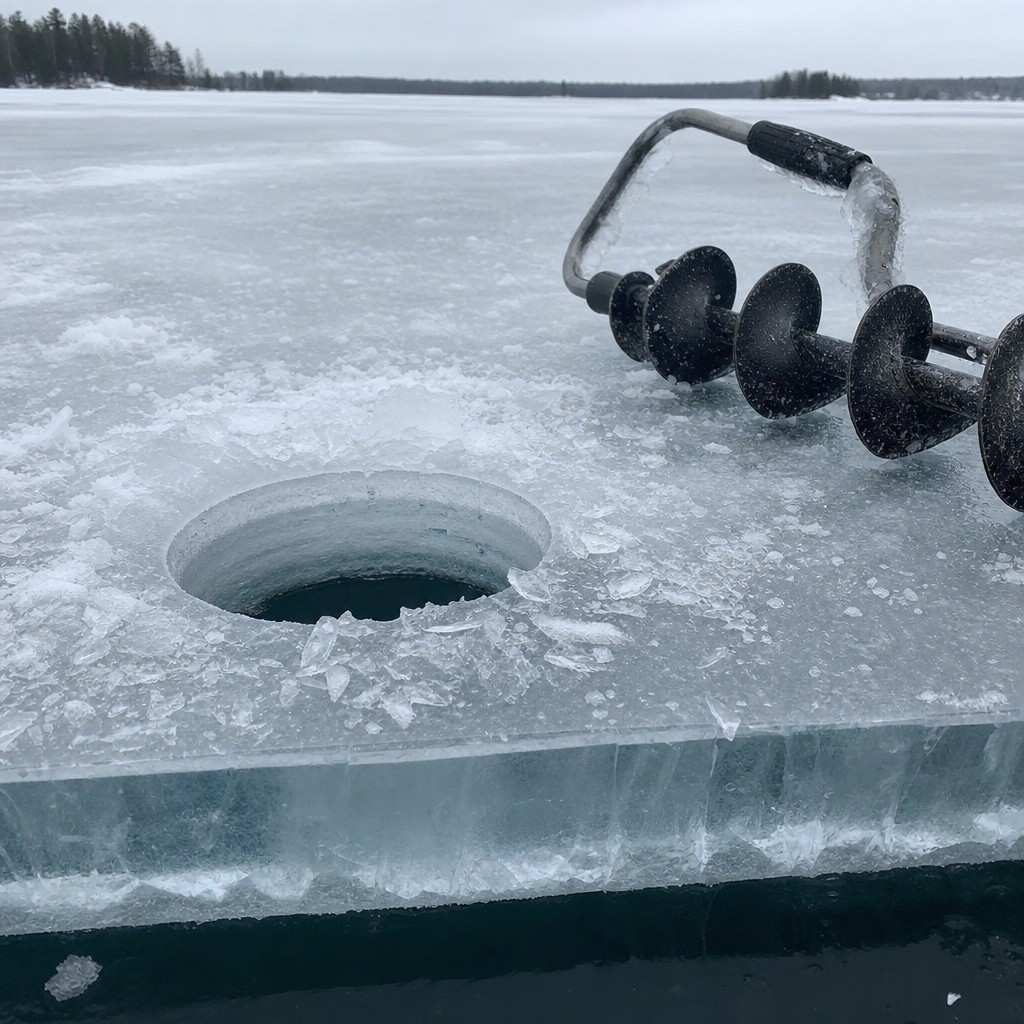
Beginners picture one safe number, drill a hole, and walk. Real ice does not cooperate.
Ice is rarely the same thickness across one body of water. The Minnesota Department of Natural Resources notes that ice can be two feet thick in one place and an inch thick a short distance away on the same lake. A current, a spring, a dock, or old snow can leave a thin window in solid ice, so one hole near the bank tells you about that spot only.
The Michigan DNR goes further: there is no reliable inch-count that guarantees safe ice. Its guidance leans on testing the ice as you go and reading its quality, not on a magic number.
A measurement is a snapshot of one hole at one moment. Safe ice is a judgment you keep making as you move.
Agencies frame thickness as a minimum to even consider going, never a promise. Check repeatedly, check ahead of where you walk, and treat every number as the floor, the same habit of reading the water to find fish you already use.
The Thickness Numbers Agencies Publish (and the Caveat on Every One)
The Minnesota DNR lists four inches of new, clear ice as the common minimum for a single person on foot. That figure is for fresh, clear ice only, and it carries the usual caveat: no ice is ever 100 percent safe.
The numbers climb with the load:
- A person on foot: four inches of new, clear ice.
- A snowmobile or ATV: several inches more than a single walker.
- A car or small truck: roughly a foot or more of good clear ice; many anglers never drive on ice at all.
Two caveats make those numbers soft:
- Clear ice and white ice are not the same strength. The Minnesota DNR notes that white or “snow” ice, formed when slush and snow freeze, is only about half as strong as clear ice. Roughly double the thickness you accept if the ice is white.
- The figures assume new ice. Late-season ice can read four inches on the tape and still be rotten inside, holding far less than fresh ice of the same depth.
Reading Ice Quality: Clear, White, and the Color That Means Stop
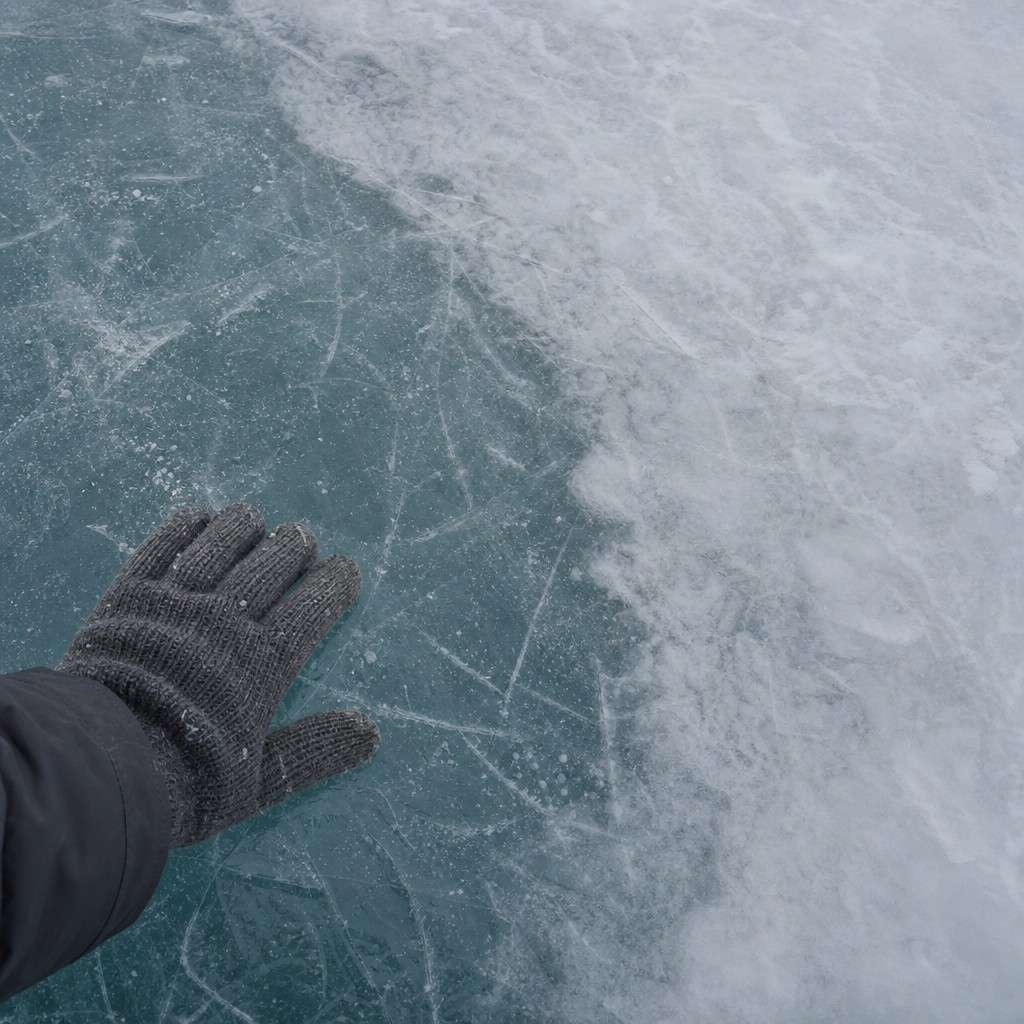
Thickness gets the headlines, but quality is what actually holds you up. Color and texture tell you a lot before you ever trust your weight to the ice.
Clear, solid ice with a bluish tint is the strong stuff. It froze slowly from the lake water itself, with no air or snow mixed in, and it carries the published numbers.
White or opaque ice is the weak stuff. It is frozen snow and slush, full of trapped air, and runs roughly half the strength of clear ice. Slush on the surface is its own warning: the ice is not freezing solidly below.
Gray, dark, or “rotten” honeycombed ice means stay off. A gray cast often signals water in or under the ice, and rotten thaw ice can collapse even where it measures thick.
A short field check before you commit:
- Look at the color from the edge before you step out. Bluish and clear is best; milky white or gray is a reason to slow down.
- Drill or chip a test hole near shore and look at the cross-section, not just the depth.
- Re-test every several yards as you move out. Good ice near the bank does not promise good ice further out.
- Listen and feel. Cracking that travels, a spongy feel underfoot, or water welling up all mean turn back.
The Weak Spots That Fool People
Even on a lake that checks out, certain places are predictably thinner. Give them room.
Moving water keeps ice thin. Inlets, outlets, channels between basins, and anywhere a current runs will be thinner than the open ice around them, sometimes dangerously thin.
Edges and shorelines shift fastest. Ice near shore weakens first in a thaw and is often undercut even when the middle looks fine. The early walk-on and late-season walk-off are when the bank is least trustworthy.
Pressure ridges, cracks, and old holes are obvious soft points. So are spots near docks, pilings, and anything dark that absorbs sun and melts the ice around it.
Early and late season are the high-risk windows. First ice can be thin and uneven, and spring ice can be rotten regardless of the tape reading. The safest is mid-winter ice built over a long, cold, stable spell.
When in doubt, pick another day or fish a spot you already checked.
What to Carry, and the Rule That Outranks All of It
Reading ice well reduces the odds of a break but never removes them. Carry rescue gear as routine.
A basic safety kit:
- Ice picks or claws worn around the neck. If you go through, they let you dig in and pull yourself out, nearly impossible with bare wet hands.
- A throw rope so a companion can reach you without coming onto the bad ice.
- A life jacket or float suit, especially in early and late season.
- A spud bar or auger to test ahead of you as you walk.
- A charged phone in a waterproof pouch.
And the rule that sits above every tip here:
Never fish ice alone, and tell someone on shore where you are and when you will be back. A second person, or just someone who knows where to send help, changes the outcome of a break more than any piece of gear.
The strongest piece of ice-safety gear is another person who knows where you are.
The same prepared mindset runs through the start-here guide to catching your first fish. Once you trust the hard water, the site’s ice fishing tips cover gear and technique.
One last honest line. This is general safety information, not a guarantee about any specific ice on any specific day. The only ice anyone can speak for is the ice you have checked yourself, alongside current advice from local authorities. When the answer to “is the ice safe?” is “I am not sure,” the answer to “should I walk on it?” is no.