
You can fish the ocean in California without owning a boat. A public pier puts you over saltwater, within reach of the same migrating fish that boats chase, with none of the cost or upkeep. It is where a lot of California anglers start, and where many stay.
The catch changes through the year as fish move with the seasons, so the same pier fishes differently in spring than it does in fall. Weather sets the limits more than gear does. Rain, fog, and wind can turn a friendly pier rough, so it is worth checking conditions before you go.
Because the species are so varied, anglers use several methods depending on what they are after:
- fly-fishing
- surf fishing
- bait-casting
- pier fishing
- and several other methods
A boat opens up thousands of miles of California coastline, but it also brings docking, trailering, maintenance, and running costs. Not every saltwater angler owns a boat, and a pier removes every one of those obstacles. There are plenty of productive spots for pier fishing in California for people without one.
How to fish the ocean without a boat
A pier is the simplest path to saltwater fishing. Fishing magazines tend to show boats, which can leave the impression that a boat is the only proper way to fish the sea. It is not.
There is a large and growing community of shore-bound anglers who fish piers, jetties, and beaches without ever leaving land.
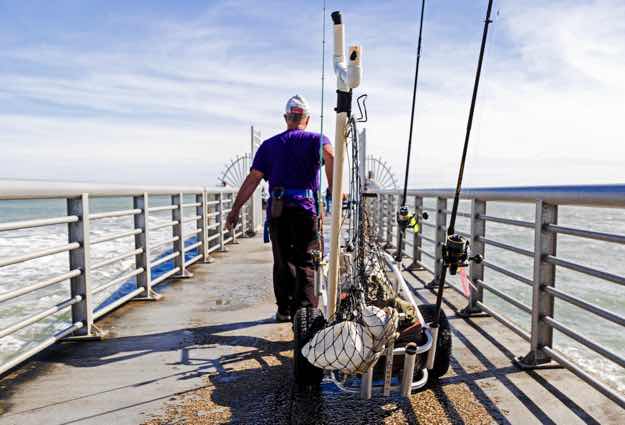
Pier anglers turn up almost everywhere along the coast, some with polished tackle and some with gear taped back together. The tackle box matters less than getting a line in the water. As long as it can be wheeled or carried out to the pier, it works.
Pier fishing rewards a little skill
You can drop a chair at a pier and start fishing, but knowing when and where to cast is what fills the bucket. Most pier fish move in waves, so timing matters as much as location. Learning to read the water is what separates a slow day from a steady one.
Much of the action is bottom fishing, where anglers often haul in two or three fish at a time. Bigger catches like mackerel and king mackerel are within reach from a pier too. At the far end you will see anglers using floats and rigs built to suspend live bait just under the surface, and the occasional kite rig that carries bait well off the structure.
Fishing with two rods
The two-rod approach is common on piers, but it is not for crowded days. One heavy rod sits with the bail open while a lighter rod holds the bait. The bait rod casts the line many yards off the pier. When a fish bites, the angler pulls the lighter rod back and fights the fish on the heavier one. Two rods simply put more bait in the water and raise the odds of a hookup.
The trade-off is space and tangles. Two rods take up more room and lines cross more easily, so on a busy pier it is better to stick to one rod and keep the peace.
You can find more pier fishing tips from saltstrong.com.
Fishing for dinner
Most pier anglers keep their catch for the table. Do not expect to see fish released here. People come to put dinner on the plate and to socialize while they wait. As a group, pier regulars tend to bring more patience, inventiveness, and endurance than most.
Fishing with children
A pier is one of the easiest places to take a child fishing. There is solid ground underfoot, room to move, and no boat to manage, so you can keep your attention on your kid instead of the vessel.
Safety comes first whatever you decide. Keep a life jacket and the rest of your safety equipment on hand at all times, and stay close enough to step in if a hook or a rail becomes a problem.
The best piers for fishing in California
Most coastal cities in California have a public or pay-to-fish pier. Many let you rent tackle and buy bait on site, and the regulars are usually happy to help if you run into trouble. There are over fifty public fishing piers in the state, with details on each at pierfishing.com.
One detail worth knowing: you do not need a fishing license to fish from a public pier in California. That makes a pier the cheapest legal way to try saltwater fishing in the state.
Long Beach is a good example. When the downtown marina was built, small piers went in along the southwest side of the peninsula just for fishing. Belmont Pier nearby is older and stays busy. At Pacifica Pier the regular catch includes mackerel, salmon, rockfish, jacksmelt, crab, halibut, surfperch, sharks, and striped bass.
Tips for fishing on a pier
Every pier fishes differently, so the locals are your best source. Ask around. You will find experienced anglers in the bait shop, on the pier at first light, and happy to share what is biting.
- Fish the edges of the day. Early morning and evening are the most reliable windows for a bite.
- Look under the pier. Fish often hold tight to the structure, closer than the long casts out front.
- Plan for the big one. Lifting a large fish straight up onto a pier is hard on the line.
For that last point, a landing net on a rope lets you scoop a heavy fish at the water rather than risk losing it on the way up. You can browse pier landing nets on Amazon if you do not already have one. EscapeSportFishing earns a commission on qualifying purchases made through some links on this page, at no extra cost to you. See the affiliate disclosure for details.
Bottom line
A little pre-trip planning pays off, but pier fishing can be as simple as you want it. Pick a pier, bring basic tackle and your safety gear, and go when the fish are feeding.
Pier fishing is about as relaxed and low-cost as saltwater fishing gets, which is exactly why it is a good place to start.